From Earlsdon to the Skies
Sir Frank Whittle was born on 1 June 1907 in a terraced house on Newcombe Road in Earlsdon, Coventry. He was the eldest son of Moses Whittle, a highly inventive practical engineer, and Sara Alice Garlick. His father later purchased the Leamington Valve and Piston Ring Company, and when Frank was nine the family moved to Royal Leamington Spa. There, the young Whittle spent much of his time in his father's workshop, becoming an expert on the single-cylinder gas engine.
Whittle's formal schooling began at Milverton School, where he studied for two years before winning a scholarship to Leamington College for Boys. Financial difficulties forced him to leave, yet he continued his education independently at Leamington reference library, reading extensively about astronomy, engineering, turbines, and the theory of flight. At the age of 15, determined to become a pilot, he applied to join the Royal Air Force in 1922.
The Cranwell Thesis That Predicted the Future
Whittle joined the RAF as an aircraft apprentice at Cranwell in September 1923. In 1928, while studying at the RAF College Cranwell, he wrote a thesis titled "Future Developments in Aircraft Design." He argued that flight at high altitudes and speeds exceeding 500 mph would require an entirely new form of propulsion, and he described what became known as the motorjet concept.
Whittle later recorded his central insight: "I came to the general conclusion that if very high speeds were to be combined with long range, it would be necessary to fly at very great height, where the low air density would greatly reduce resistance in proportion to speed." After abandoning the motorjet idea, he conceived the turbojet; a design using a turbine to extract power from the exhaust to drive a compressor. In January 1930 he submitted the patent that would form the basis of the modern jet engine.
From Workshop to Warplane
On 24 May 1930, Whittle married Dorothy Mary Lee in Coventry. He continued his RAF career while refining his engine design, and in March 1936 Power Jets Ltd was incorporated to develop the concept commercially. After further study at Peterhouse, Cambridge, where he graduated with a First in Mechanical Sciences, his work accelerated.
The Power Jets WU, or Whittle Unit, ran for the first time on 12 April 1937. On 15 May 1941, the Gloster E.28/39 aircraft, powered by Whittle's engine, made its maiden flight from Cranwell. This was the first British jet aircraft, and it led directly to the Gloster Meteor, Britain's first operational jet fighter. By the end of the Second World War, every major British engine company was working on jet designs based on Whittle's pattern.
Honours and Later Life
Whittle retired from the RAF in 1948 with the rank of Air Commodore and was knighted the same year. His awards included the Order of Merit, Companion of the Order of the Bath, and Fellowship of the Royal Society. In 2002 he was ranked number 42 in the BBC poll of the 100 Greatest Britons.
He emigrated to the United States in 1976 and died on 8 August 1996 in Columbia, Maryland, at the age of 89.
A Lasting Memorial in Coventry
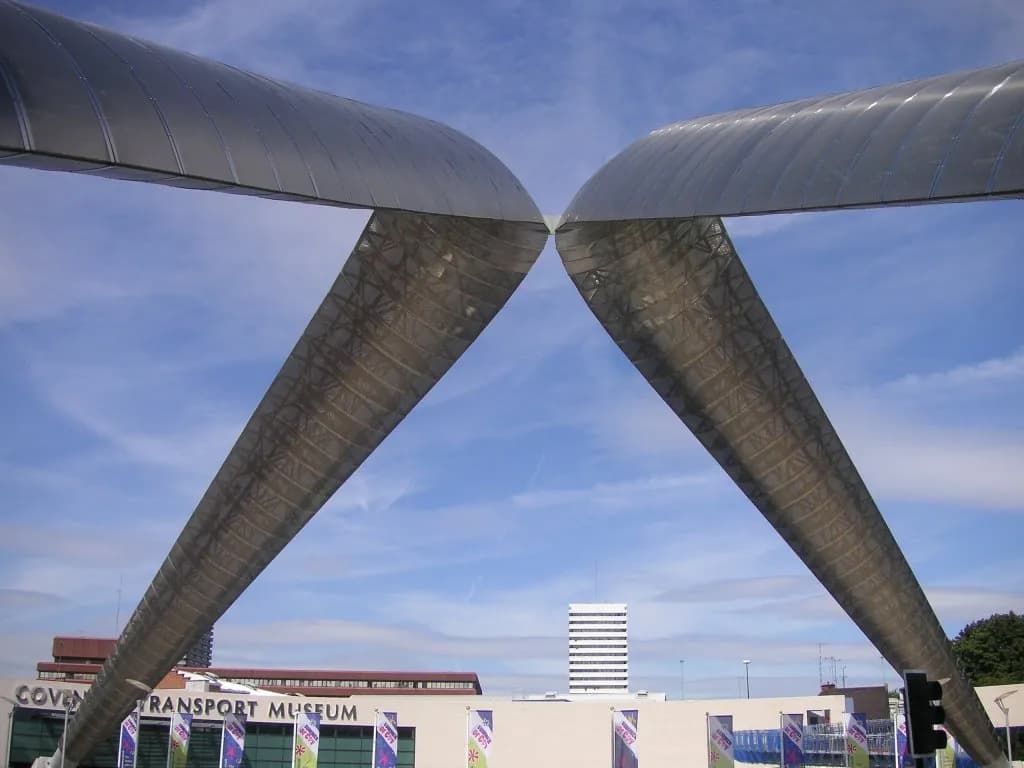
Coventry has not forgotten its native son. The Whittle Arch dominates Millennium Place outside Coventry Transport Museum. Completed in 2003 as part of the Phoenix Initiative regeneration project, the structure spans 60 metres and rises 15 metres high. Designed by MacCormac Jamieson Prichard, its steel aerofoil section and stainless steel mesh stand as a striking tribute to the man who took aviation from propellers to jet power. His birthplace on Newcombe Road remains standing, a quiet reminder that world-changing ideas can emerge from ordinary streets.