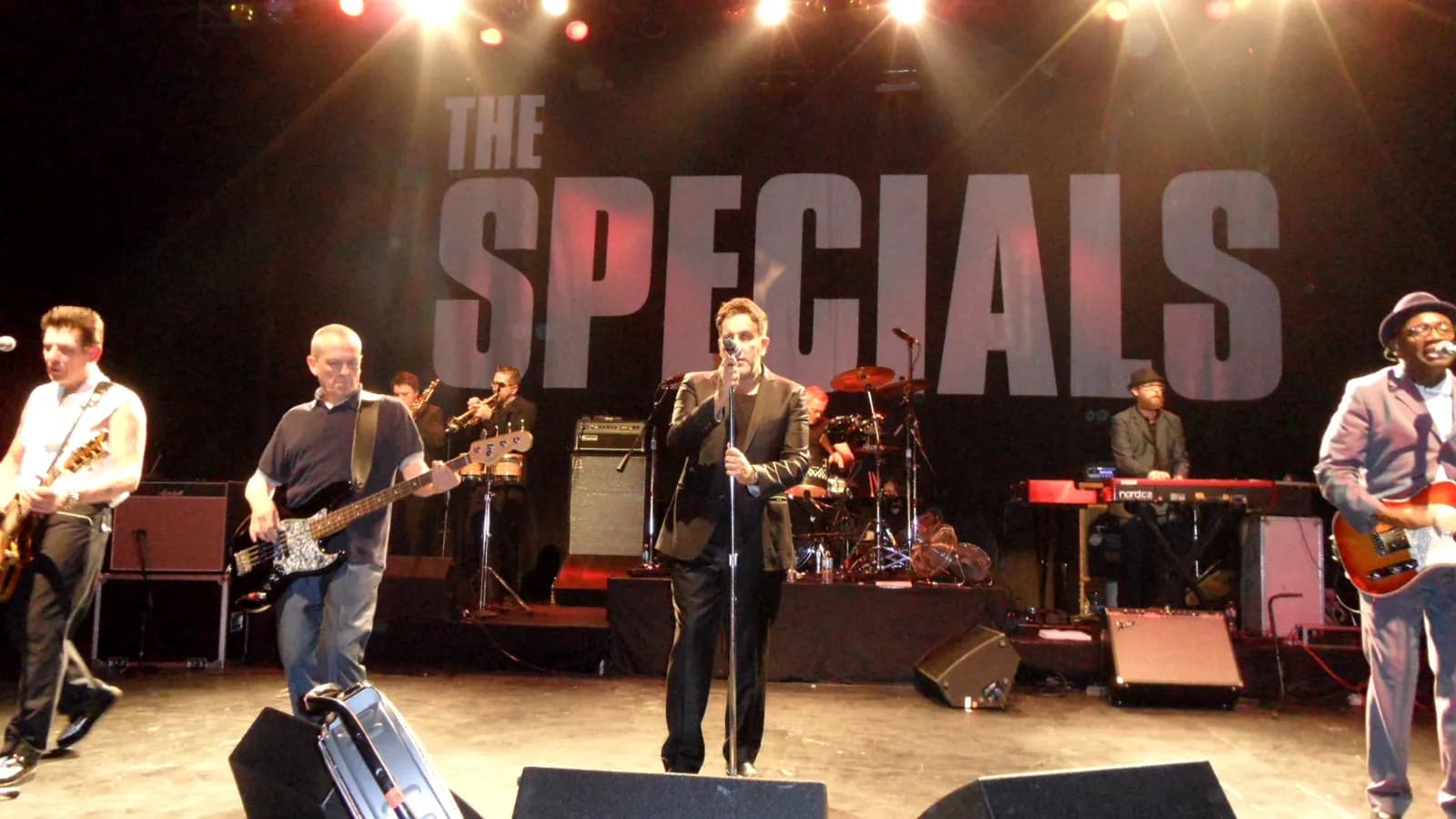
In 1977, a group of young musicians in Coventry began rehearsing under the name the Coventry Automatics. Within two years they had become The Specials, and their fusion of Jamaican ska and British punk would define the 2 Tone genre and produce a UK chart-topping hit.
Formation in Coventry, 1977
Keyboardist Jerry Dammers, who had moved to Coventry at the age of ten and later studied art at Lanchester Polytechnic, founded the band in the city. The original line-up included vocalist Tim Strickland, guitarist and vocalist Lynval Golding, drummer Silverton Hutchinson, and bassist Horace Panter. Terry Hall replaced Strickland on vocals shortly afterwards, and guitarist Roddy Byers, known as Roddy Radiation, joined in March 1978. The group initially performed as the Coventry Automatics before adopting the name The Special AKA and eventually settling on The Specials.
A Label on Albany Road
In 1979, Dammers established 2 Tone Records with backing from Chrysalis Records. The label’s headquarters were at 51 Albany Road in Earlsdon, Coventry. Its first release was the double A-side single “Gangsters” backed with “The Selecter,” which reached the UK Top Ten. The label’s visual identity, the cartoon figure Walt Jabsco in a pork pie hat and black suit, drew on a photograph of Peter Tosh and an old American bowling shirt owned by Dammers.
The Locarno and the Sound Systems
Coventry’s clubs provided the setting where the scene’s key figures met and developed their skills. Neville Staple, born in Jamaica and raised in Coventry after arriving in England as a small child, was a regular at the Locarno Ballroom. He had honed his toasting skills on local sound systems, including his own Jah Baddis system, before joining The Specials first as a roadie and later as a full member. The city’s dance halls and sound system culture gave the emerging 2 Tone sound its rhythmic foundation.
A Deliberately Multiracial Band
Dammers formed The Specials with the explicit intention of creating a multiracial group. He selected members to ensure black and white musicians performed together, viewing the band as a vehicle for anti-racist politics during a period of heightened racial tension in Britain. The 2 Tone genre itself, which originated among young musicians in Coventry who had grown up listening to 1960s Jamaican music, took its name from this ethos of integration. Bands associated with the movement routinely featured mixed line-ups and adopted the rude boy fashion of pork pie hats, tonic suits, and loafers as a visual statement of unity.
The Selecter and the Wider Coventry Scene
The Selecter formed in Coventry in 1979, taking their name from the instrumental track that appeared on the B-side of The Specials’ debut single. The original line-up included Neol Davies on guitar, vocalists Arthur ‘Gaps’ Hendrickson and Pauline Black, and Hammond organ player Desmond Brown, among others. Davies and drummer John Bradbury had recorded the track “Kingston Affair” in 1977 and 1978 with Coventry producer Roger Lomas, demonstrating that the city’s ska revival was already under way before The Specials’ first release.
Legacy in the City
Coventry has preserved the memory of the 2 Tone movement through several local initiatives. A museum, café, and venue called 2-Tone Central opened in the Coventry University Students’ Union building on 1 October 2010, before relocating to the 2-Tone Village in Stoke. The Coventry Music Wall of Fame also honours the musicians who shaped the city’s international reputation. What began in Coventry rehearsal rooms, polytechnic corridors, and the Locarno Ballroom became a sound and a statement that travelled far beyond the West Midlands.