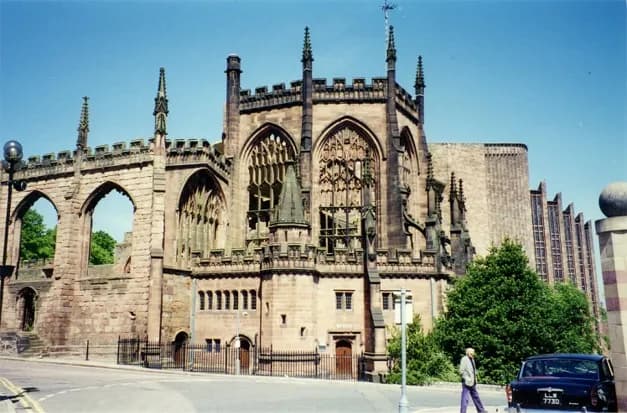
Coventry's city centre is home to two extraordinary attractions that tell the story of Britain's past: the haunting ruins of St Michael's Cathedral, destroyed during the Second World War, and the Coventry Transport Museum, holder of the world's most extensive collection of British-made road transport.
The Cathedral: A Symbol of Resilience
St Michael's Cathedral stands as one of Coventry's most powerful landmarks. The medieval structure was bombed by the German air force in November 1940 during the Coventry Blitz, leaving the roofless shell that visitors see today.
Prime Minister Winston Churchill visited the ruined nave shortly after the bombing, walking through the devastation with the Mayor of Coventry and clergy members. Official war photographs from the period capture the scale of the destruction.
The ruins that remain include the chancel apse, the south aisle, and sections of the nave arcade. Preservation efforts have installed reinforcing tie rods and anchor plates to stabilise the medieval stonework. A cross fashioned from charred roof beams was placed on the site of the high altar, visible in photographs taken as early as Spring 1944 when a path had been cleared through the rubble.
Rather than clearing the site entirely, Coventry chose to preserve the ruins as a memorial and build a new cathedral alongside. This decision created a unique space where the destroyed medieval church stands in dialogue with its modern successor, attracting visitors from across the world who come to reflect on themes of destruction, reconciliation, and peace.
The Transport Museum: Britain's Motoring Heritage
The Coventry Transport Museum, located in Coventry City Centre, houses what curators describe as the most extensive collection of British-made road transport in existence.
The museum's location in Coventry reflects the city's historical position as the centre of the British car industry. When the museum opened (originally as the Museum of British Road Transport), it celebrated the region's manufacturing heritage that had made Coventry synonymous with motor production.
Exhibits include the BloodhoundSSC, the British land speed record vehicle designed to exceed 1,000 miles per hour. The collection spans the history of British road transport, from early cycles and motorcars to commercial vehicles and speed record challengers.
Why These Attractions Matter Locally
For Coventry residents, these two sites represent different but complementary aspects of local identity. The cathedral ruins speak to the city's experience during the Second World War and its subsequent role in international reconciliation efforts. The transport museum preserves the memory of Coventry's industrial past and its contribution to British manufacturing.
Both attractions draw significant visitor numbers to the city centre, supporting local businesses and maintaining Coventry's place on the cultural map. The cathedral remains an active place of worship and a centre for the international Community of the Cross of Nails, whilst the museum continues to expand its collections and exhibitions.
Together, they offer residents and visitors alike a tangible connection to the events and industries that shaped modern Coventry.